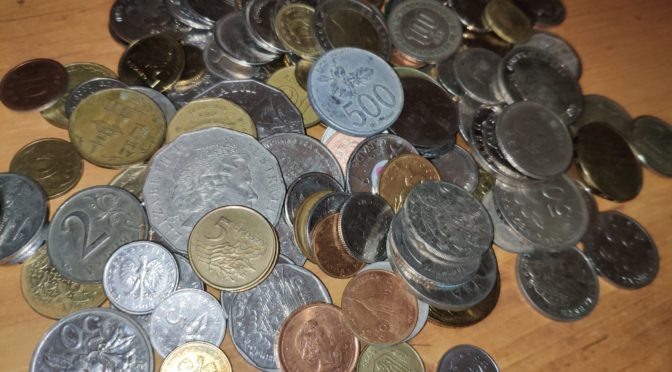
It’s one of those things that just seems to happen to you when you travel: you accumulate money. I’m not talking money as in savings, lol, no, not at all. But I am talking about all of that loose change that gathers in your pocket or backpack as you move from one country to another. Oftentimes, currency exchange people won’t take it so you have the choice to either keep it as a souvenir or to give it away as a tip or to someone needy. Well, I tend to keep it because I don’t believe in tipping the currency exchange people (which is usually when I find out I have all of this change, so, over the years, I’ve accumulated quite a stash.
The curious thing is that some of that currency you hold is actually made in my hometown of Winnipeg. So it is with some curiosity that I decided to take a trip to see the facility where they make coins for clients around the world. I’m referring to the Royal Canadian Mint, located on Lagermodiere Boulevard.
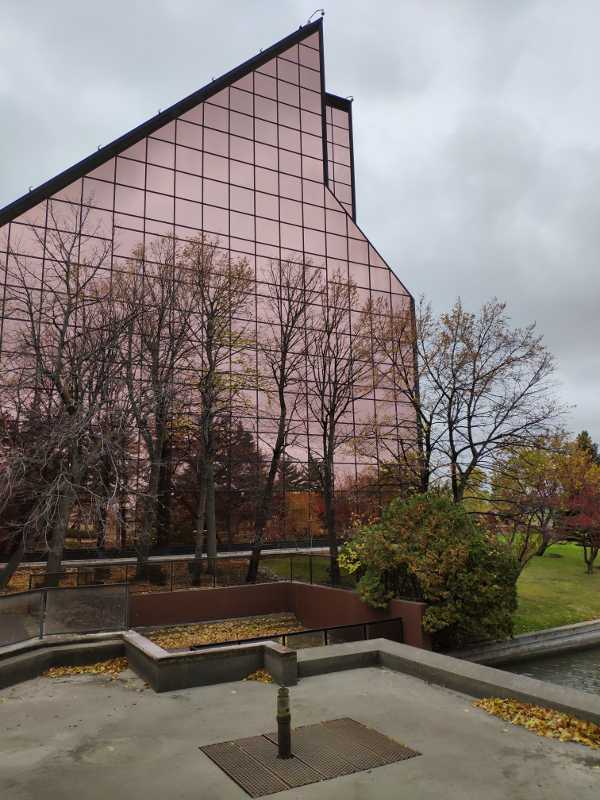
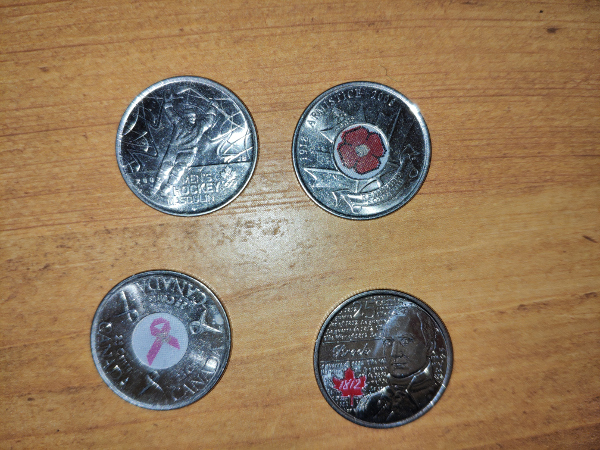
As you drive in, the drive way hosts a series of flags that represent the various countries that have utilized the Mint’s services. Not just Canada but the USA, Brazil, Singapore, Ukraine, China, and many others. Now, most of those countries don’t ask for the same things that the Canadian monetary system has, that is, multi-coloured coins (poppies or ribbons by chance?) or two-part coins (such as the Canadian toonie). You see, as much as the Mint makes coins for use in Canada, it also actively researches and experiments with coin-making technology. (Though it’s the Ottawa Mint that makes collectors’ coins whereas the Winnipeg Mint focuses on circulation coins.)
They were understaffed on the day I went but I could go on a self-guided tour. I took my time to watch the workers on the floor amongst all the machines that were driving and delivering coins this way and that. It’s a well-oiled machine and you can watch the different stations at work. One thing I thought was neat was that the videos that they had on display for the public still had some of the same people working! Sadly, no pictures were allowed so I had to content myself with reading the captions and watching the people working below.
Seeing as though I had all of these travel coins, I wanted to talk to somebody who would know more than me and be able to help me understand this whole area of money. I was curious, I’d never bought a coin but I knew that there were people out there who would pay a decent sum of money for a coin they cannot or will not use. So I stopped by the boutique and, among the shiny and expensive coins on display, I talked to the ladies working there.
So who buys gold coins?
Tourists. Coin collectors.
Who buys these expensive ones?
Mostly coin collectors. Lots of tourists from China and India.
I mentioned that I work in China and that I’ve never seen or heard anybody talk about gold, especially not coins. To which the lady responded, if people have something as valuable as these things, they probably wouldn’t talk about them very openly. Good point.
What do they buy them for?
Mostly cause they’re look nice.
That’s the only reason?
Most of the coin collectors who come in to buy usually have a family history of collecting coins.
So, for inheritance purposes or something like that?
Nope, a few of the people who collect these coins are single and have no one to gift them to.
Huh? So this hobby could be a foreshadowing of a single life?
No, but, again, it usually runs in the family.
Which one sold out the fastest?
The Ukrainian pysanka, made available in 2016, 2017 and 2018. We had line-ups around the block.
Which one would you recommend for someone to buy if it’s their first coin?
Something that grabs your eye. Something that you would like to look at.
She pointed out a few of them and asked my budget. I said I was just interested. She ended up pointing out a few of different qualities and prices:
- The new bumble bee collector’s coin ($569)
- The World War 2 helmet ($199)
- Fractional Gold Set ($2999)
- Dancing Man ($189)
- Silver dollar ($29)
- A special edition steel coin ($29)
I looked through them with some interest though I wasn’t sure if I could justify the cost. I mean, when you buy these things, you kinda need to hold onto them for a while before they become worth anything. It’s not like a house or stocks where you can flip them quickly for a profit.
But I had one more question I needed to ask this numismatic lady:
So, would my travel coins be worth anything?
Well, probably not, other than their face value.
Why?
They’re not rare and there are still a lot of them in circulation, and they don’t have any mistakes on them. If I were to hold them long enough, they might be worth something, provided that they don’t desintegrate along the way. Also, the difference between circulation coins and collectables is that circulation coins are made using alloys whereas collectables are made with precious metals (such as silver and gold or platinum) and are made in limited quantities (lots of 1,000-30,000). The lower the lot, the more likely the collectable will be worth something in the future.
The other thing to look for, if you’re not willing to spend much on coins, is to buy proof coins, which are struck two or three times instead of only once (like circulated sets).
So, it’s unlikely I’d have that rare coin?
Not unlikely, but the reason why most coins appreciate in value so much is because they simply become unavailable. If you had the last penny struck by the Canadian Mint in 2012, then that one would appreciate in value more over time.
***
So, although I can feel international by having a tin full of coins that may be worth their face value, it’s not like they’re going to be worth millions later in the future. It may be that they simply get old and rusty before they are given away or sold for scrap.
Well, there goes that investing plan.
Now, what do I do with all of that left over paper money?!